How to Teach Mindset to Kids at Home: Proven Strategies to Build Confident and Resilient Children
Learn how to teach mindset to kids at home through simple, everyday activities. Build confidence, strengthen emotional intelligence, and inspire a lifelong love of learning in your child.
Why Mindset Is the Foundation of a Child’s Future
Every parent dreams of raising children who are confident, optimistic, and emotionally strong. Beyond intelligence or talent, it’s a child’s mindset that shapes how they face life. Research by psychologist Dr. Carol Dweck introduced the idea of the growth mindset, showing that children who believe they can grow their abilities through effort and persistence achieve more and handle obstacles better.
Helping your kids develop this kind of thinking at home gives them a lifelong advantage. You don’t need to be a teacher — just a parent who models curiosity, reflection, and resilience in daily life.
Understanding What “Mindset” Means
A mindset is the internal story we tell ourselves about what we can and can’t do.
Fixed Mindset: Belief that ability or intelligence is unchangeable (“I’m just not good at math”).
Growth Mindset: Belief that effort and learning can improve performance (“I can get better if I keep practicing”).
Children move between these two depending on the situation. Your daily words, tone, and reactions shape how they see effort, failure, and progress.
How Parents Influence a Child’s Mindset
Children watch more than they listen. The way you handle failure, effort, or frustration directly influences their internal language.
Embrace your own mistakes.
When kids see you recover from errors positively — like burning a meal or missing a deadline — they learn that mistakes aren’t disasters, just data for improvement.Praise the process, not the result.
Replace “You’re so smart” with “You worked hard on that.” It focuses attention on effort and persistence rather than innate ability.Reframe failure as feedback.
Instead of asking “Why did you mess up?”, say “What can we learn from this experience?”Share your personal growth stories.
Tell your kids about a time you practiced something until you improved. It humanizes the learning process.
Consistency here is powerful — small shifts build lasting beliefs.
Everyday Steps to Teach Growth Mindset at Home
1. Begin the Day with Positive Thoughts
Encourage your child to start mornings with simple affirmations such as:
“I can always learn something new.”
“Mistakes help me improve.”
“I am kind, focused, and patient.”
Seeing or speaking these daily strengthens confidence and emotional grounding.
2. Explain How the Brain Grows
Kids love visuals. Tell them, “Your brain is a muscle — every time you try something challenging, it gets stronger.” This metaphor helps kids link effort with growth rather than stress with failure.
3. Appreciate Effort Over Outcome
When your child solves a puzzle or finishes homework, highlight persistence: “You really focused until you solved it.” This builds motivation rooted in effort, not external validation.
4. Use the Word “Yet” Often
Whenever your child says, “I can’t do this,” gently reply, “...yet.” That one word turns self-doubt into possibility and opens their mind to growth.
5. Keep a “Learning Log”
Encourage kids to record what they learned each day — one new idea, one mistake, and one thing they’re proud of. This reflection strengthens self-awareness and resilience.
6. Tell Stories of Real Struggle and Triumph
Share biographies or bedtime stories about people who achieved success after failure — scientists, athletes, or artists. Ask your child questions like “What made them keep going?”
7. Create Weekly Challenges
Try fun comfort-zone stretchers — cooking together, solving a new kind of puzzle, or learning a skill like drawing or tying knots. Celebrate the courage to try, not the perfection of the result.
8. Make Family Reflection a Routine
Once a week, gather and talk about something everyone found difficult and how they handled it. This builds emotional literacy and shows that growth is a shared family value.
Building Mindset Alongside Emotional Intelligence
A growth mindset works best with emotional awareness. Teach your child how to name and handle their feelings instead of hiding them.
Use an emotion chart with drawings to help them identify feelings.
Practice deep breathing when emotions run high.
Create a calm space where they can rest or draw when upset.
When children understand that emotions can be managed, challenges no longer feel overwhelming.
Why Encouragement Fuels Motivation
Consistent positive feedback lights up the brain’s reward circuits, making effort feel satisfying. Rather than rewarding with toys or treats, reward persistence with recognition:
“You didn’t give up when it got tough. That’s real strength.”
“It took patience, and you found another way.”
This approach teaches children to feel proud of their internal progress rather than external approval.
Turn Daily Routines into Mindset Lessons
Mindset teaching doesn’t need big lessons — every small interaction counts.
While cooking: Let them handle measurements and make adjustments. Mistakes become mini science experiments.
During homework: Ask guiding questions instead of giving answers, promoting problem-solving.
During play: Focus on teamwork, turn-taking, and managing frustration.
At emotional moments: After tears or arguments, talk about what could be done differently next time.
Parenting moments often double as mindset-building moments when we slow down and engage consciously.
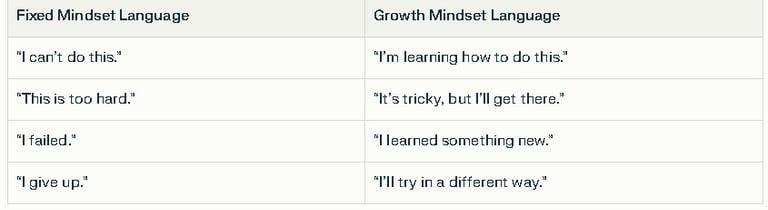
Language Makes the Difference
The words we use shape how children interpret effort and identity. Replace negative scripts with growth-centered reflections.
Use these repeatedly. Over time, they rewire how your child speaks — and thinks — about challenges.
Teaching Kids to Step Beyond Comfort
Children naturally avoid tasks that make them feel incompetent. Help them see challenge as a signal of growth, not weakness.
Praise bravery over ease.
Encourage experiments and mistakes.
Ask open-ended reflection questions: “What did that teach you?”
This process nurtures confidence built on progress, not comparison.
Fun Mindset Games and Activities
Here are simple, interactive activities that make learning mindset fun for the whole family:
The Challenge Jar – Fill a jar with small challenges like “Write with your non-writing hand” or “Solve a riddle.” Reflect after each.
Resilience Bingo – Create a bingo sheet of actions like “Kept trying,” “Helped someone,” or “Tried something new.”
Inventor’s Lab – Give household objects for creative projects that require problem-solving.
What Would You Do? – Tell short stories of challenges and ask how they would respond to turn it into a teaching dialogue.
Play-based activities make these concepts stick naturally.
Staying Consistent as a Parent
Instilling mindset takes time — it’s cultivated across consistent small actions.
Be mindful of your words. Notice when you emphasize results instead of effort.
Allow natural consequences. It helps children learn responsibility and self-correction.
Celebrate small wins often. Recognition keeps motivation strong.
Stay patient through setbacks. Transformation happens through gradual reinforcement.
Your calm consistency is the environment where self-belief grows.
Adding Mindfulness and Gratitude Practices
Combining growth mindset with simple spiritual practices helps children develop focus and peace alongside ambition.
Have a short gratitude ritual before bed (“What made us happy today?”).
Teach mindful breathing before stressful situations.
Take gratitude walks together, noticing sounds, colors, or smells.
Such small, present-moment exercises teach that peaceful attention can coexist with striving.
Common Parenting Mistakes That Block Mindset Growth
Even with good intentions, certain patterns can unknowingly create fixed thinking:
Correcting too quickly instead of allowing them to find solutions.
Comparing children to each other.
Praising results rather than effort.
Using labels like “You’re shy” or “You’re smart.”
Shift from labeling to describing effort: “You kept practicing until it worked.” Over time, your language slowly becomes their inner voice.
Using Technology Mindfully in Mindset Learning
Digital resources can support your parenting goals when chosen wisely. Apps like Moshi, Khan Academy Kids, or Smiling Mind introduce emotional regulation, storytelling, and problem-solving.
Always pair screen time with discussions — ask, “What did you learn or notice?” to strengthen transfer from digital to real-world awareness.
The Long-Term Impact of Teaching Mindset at Home
Kids raised in mindset-rich environments tend to:
Approach mistakes calmly.
Show resilience in academics and friendships.
Maintain motivation under challenges.
Respect effort — their own and others’.
They grow into adults who adapt well, handle criticism constructively, and see change as a chance for discovery instead of defeat.
Final Reflection: Every Parent Is a Mindset Teacher
Teaching mindset isn’t just a parenting strategy — it’s an everyday philosophy. Your tone, patience, and actions shape how your child sees learning, failure, and possibility.
When you model gratitude, perseverance, and curiosity, your home becomes a living classroom of growth.
You don’t need perfect words — just honest effort. Because in the end, kids learn mindset not from what we teach, but from how we live.
CONTACT 24/7
talkwithpandya@gmail.com
© 2025. All rights reserved.