Identity Shift: Transforming Self-Perception
Discover how transforming self-perception can lead to significant changes in our lives. Explore the psychology of identity and the power of change to reshape your decisions and experiences.
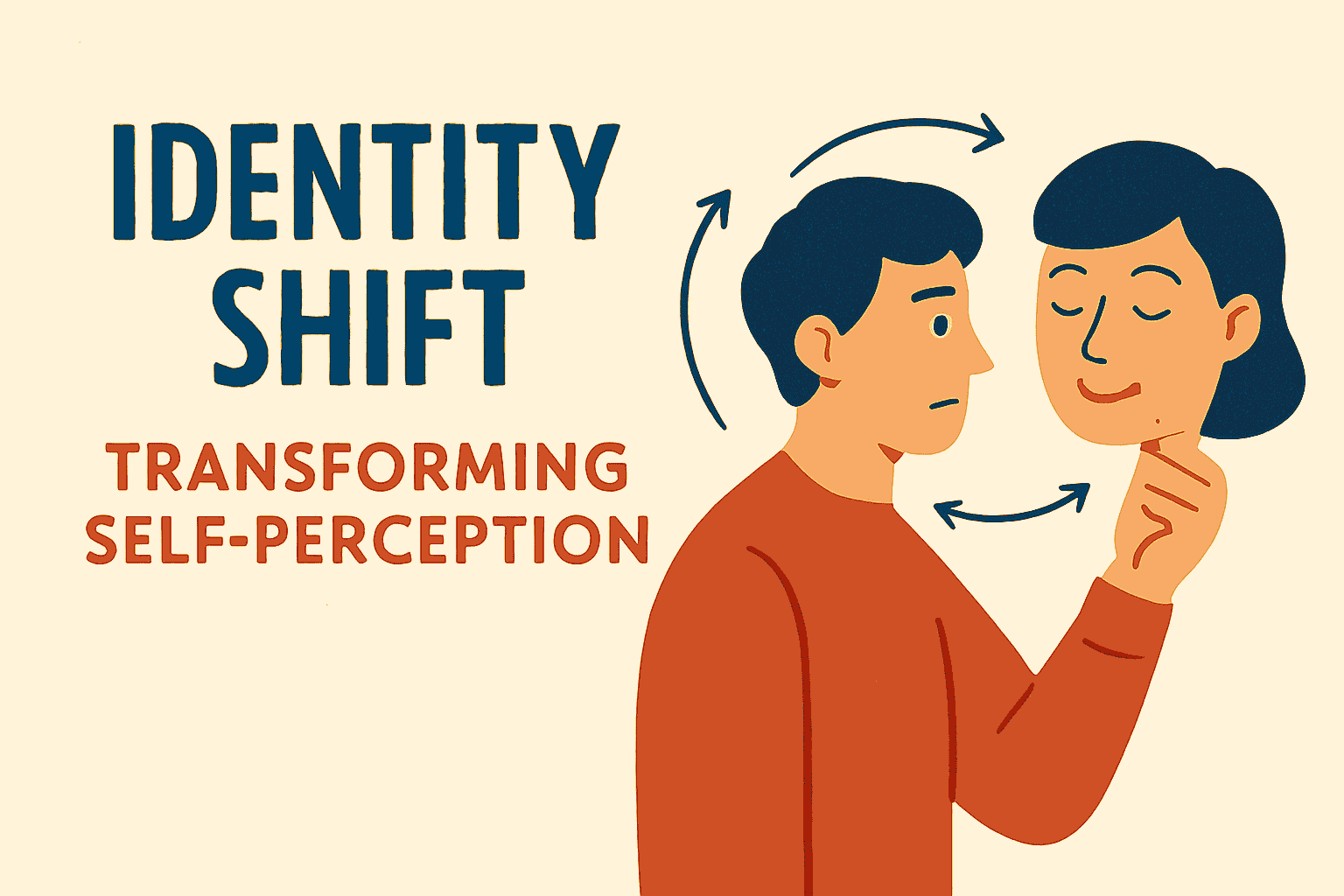
Identity Shift: How Transforming Self-Perception Shapes Life’s Biggest Decisions
Introduction: The Puzzle of Identity and the Power of Change
Who are you, really? It’s a deceptively simple question—one that sits at the heart of psychology and quietly steers the decisions we make throughout our lives. Human identity, contrary to popular belief, is not a fixed, immutable trait. Rather, it is a living, evolving construct—shaped by our beliefs, values, self-perception, cultural background, and social interactions. Every new challenge, relationship, or life event presents an opportunity for an identity shift: a fundamental change in how we see ourselves and our place in the world.
Significant life choices are frequently preceded or go hand in hand with these internal changes. Whether it’s a dramatic career pivot, the end (or beginning) of a relationship, moving across continents, or a radical overhaul of daily habits, individuals fundamentally change because their sense of identity has moved first. This comprehensive blog explores the psychological engines behind identity shift, examining how transformations in self-concept, values, and roles inspire lasting, sometimes courageous choices.
Drawing from established psychological theories, the latest research, timely real-life examples, and practical strategies, we’ll unravel how identity shifts happen, why they matter, and how you can intentionally harness them for greater fulfillment and growth.
Understanding Identity Shift: The Foundations
What Is an Identity Shift?
An identity shift occurs when an individual’s core sense of self—how they perceive their abilities, values, roles, and purpose—undergoes significant transformation. This is often catalyzed by life events, social context, or conscious self-reflection. Unlike surface-level changes or temporary behaviors, a true identity shift realigns how someone internally views “who they are,” which in turn ripples out to influence thoughts, emotions, and concrete choices.
Psychology theorizes identity as both personal (internal self-concept) and social (defined through relationships and group membership). When these facets evolve—either through sudden events or gradual growth—the individual’s world can shift on its axis. This can feel exhilarating, liberating, unnerving, or even destabilizing, yet these moments are often at the root of our most transformative life decisions.
Core Psychological Theories of Identity Shift
To understand why and how identity shifts drive our biggest life choices, it’s crucial to explore the foundational psychological theories that describe identity’s creation and evolution.
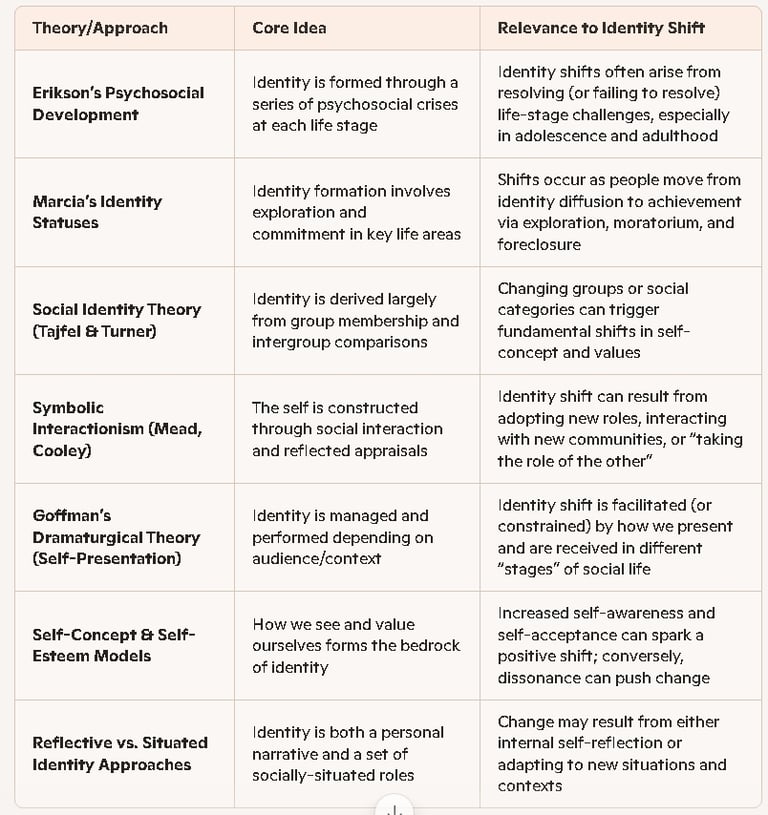
Table: Key Psychological Theories on Identity Shift
Each of these perspectives offers unique insight into the mechanisms and triggers of identity transformation. Let’s delve into several of the most influential theories and approaches.
Erikson’s Psychosocial Development and Identity
Erik Erikson famously argued that identity is not fixed at adolescence but instead continues to evolve through all stages of life, guided by a series of psychosocial “crises” or developmental challenges. In adolescence, individuals face “identity vs. role confusion”—a period marked by experimentation, self-doubt, and discovery.
If a teenager successfully navigates this stage, they emerge with a strong sense of self and fidelity to their values. If they fail, they may experience confusion, indecisiveness, or a tendency to drift between roles and relationships—a pattern that often persists into adulthood. Erikson’s model suggests that identity may be disrupted and reconstructed at other pivotal phases, particularly during transitions such as mid-life (generativity vs. stagnation) or retirement (integrity vs. despair).
The implication? Major life decisions, from changing jobs to ending relationships, frequently arise when we hit one of life’s “identity crises” and feel called to realign with a deeper or more authentic sense of ourselves.
Social Identity Theory: Group Membership and Identity
Social Identity Theory, developed by Henri Tajfel and John Turner, asserts that much of our identity is tied to the groups with which we affiliate—nationality, profession, gender, religion, and so on. By defining ourselves and others in group terms, we derive self-esteem, belonging, and a sense of purpose. Shifts in group membership—by choice or circumstance—can either threaten or enhance identity.
For example, many individuals experience profound change when they leave behind an identity-anchoring community (such as leaving a religious organization or moving abroad), or when they actively seek entry into a new group (such as joining a professional association, activist movement, or adopting a new cultural identity).
Group identity is not only a collective phenomenon but also deeply personal. People may switch groups, defend group values, or respond to stigmatization as part of their ongoing process of identity negotiation.
Symbolic Interactionism and the “Looking-Glass Self”
Symbolic Interactionism, championed by George Herbert Mead and Charles Horton Cooley, posits that our sense of self is constructed through interaction and reflected appraisal. The “looking-glass self” encapsulates the process by which we imagine how others see us, interpret their reactions, and internalize these appraisals into our self-concept.
Adopting new roles (such as becoming a parent, manager, or immigrant) transforms not only how others perceive us but also how we perceive ourselves. Consequently, changes in our social landscape catalyze shifts in identity, which may in turn lead us to make bold, life-altering decisions to align our external lives with our revised self-perception.
Goffman and Dramaturgical Self-Presentation
According to Erving Goffman, daily social life is like a play. We present various selves in different “stages” (contexts), employing impression management to influence how others perceive us. Goffman distinguishes between “front stage” (our curated, public persona) and “back stage” (our private self), with identity shift sometimes occurring as we realign our public presentation with evolving internal narratives.
A conscious decision to adopt a new identity—such as “I am sober,” “I am an entrepreneur,” or “I am no longer a victim”—may require a restructuring of one’s social performances and spaces. This can be challenging, as others’ expectations sometimes lag behind or resist our desired transformation.
Identity Shift Theory (IST)
Recent research formalizes the process of identity shift as a theoretically distinct phenomenon, especially in the context of digital life. Identity Shift Theory explores how intentional self-presentation—often in online contexts—can spark real, lasting changes in self-concept. This can happen when we become more comfortable with a new aspect of ourselves through repeated “performances” in front of chosen audiences (online communities, new peer groups, etc.).
Such identity shifts are not superficial; given enough time and social validation, they can catalyze deep personal change, influence decision-making, and “stick” through reinforcement and feedback loops.
The Four Core Influences on Identity: A Framework for Life Transformation
Psychologists have identified four broad, interlocking influences that shape (and reshape) our sense of self:
Universal Human Realities: Our understanding of life stages, mortality, purpose, and meaning.
Cultural Influences: The values, norms, and expectations of our broader society or heritage.
Family of Origin: The direct influences of parents, caregivers, early communities, and key relationships.
Personal Life Experiences: Unique successes, failures, traumas, and triumphs that leave lasting marks.
Every major life decision is filtered through this complex lattice. For instance, the choice to leave a high-paying corporate job might arise from a universal search for meaning (existential yearning), misalignment between personal and corporate cultural values, unmet needs dating back to family expectations, or a recent life-altering event such as a health scare.
By reflecting on each of these layers—and how they have shaped our current identity—we gain insight into why a specific turning point feels inevitable, and how best to navigate the transition ahead.
Triggers and Catalysts for Identity Shifts
Not all identity shifts are consciously chosen. Often, they are triggered—sometimes abruptly—by external events or gradual internal processes.
Common catalysts include:
Major life transitions (career changes, retirement, parenthood, separation/divorce, or the “empty nest” phase)
Traumatic events (loss of a loved one, illness, financial upheaval, migration, or legal challenges)
Achievement or failure milestones (graduation, promotion, award, bankruptcy, layoff)
Social and cultural evolution (coming out, changing religion, navigating new societal norms)
Internal stirrings (existential questioning, spiritual awakening, or persistent dissatisfaction)
For instance, the COVID-19 pandemic prompted millions to question their career choices, values, and goals, leading to wide-scale identity shifts and The Great Resignation. In the face of adversity and uncertainty, people reassessed their sense of purpose and pivoted towards new paths with greater resilience and adaptability.
Identity Shift in Major Life Decisions
Let’s examine how identity shifts manifest across common domains of transformative life choices.
1. Career Transitions: Decoding Professional Identity
Career is one of the most salient pillars of modern identity. When we introduce ourselves, our job title often follows our name—signifying not just what we do, but who we believe we are.
A major career change (such as switching industries, launching a business, or opting out of the workforce altogether) usually arises from a transformation in self-perception. Internal prompts might include the realization that your values have diverged from your profession, that your talents are underutilized, or that you crave meaning beyond monetary reward.
For example, a corporate lawyer who leaves to become a landscape designer is not just changing daily tasks—she is asserting a new narrative (“I am a creator, not an enforcer of rules”) and reconfiguring her sense of self-competence, purpose, and social role.
These shifts can be daunting. Career identity develops over years and is reinforced by family, societal expectations, and financial ties. Yet, evidence shows that successful transitions are likelier when individuals engage in deep self-reflection, challenge limiting beliefs, and experiment with new roles before committing—mirroring Marcia’s identity exploration process.
Real-Life Examples
Anita’s Mid-Career Shift: Anita, a teacher, transitioned to content writing by mapping transferable skills, gradually building confidence and a professional network, and reimagining her sense of self-worth. Within a year, she had created a new career identity and secured a full-time role.
Pandemic-Induced Career Redesign: University graduates and professionals during COVID-19 made unexpected shifts, sometimes abandoning long-held plans for new careers in digital fields, remote work, or creative industries, driven by both opportunity and existential necessity.
2. Relationships and Identity Dissonance
Romantic partnerships and friendships profoundly shape our identity. As people grow at different rates—or pursue diverging values—relationships may face what psychologists call “identity dissonance”.
If one partner undertakes personal growth (through therapy, spirituality, or new passions) while the other remains unchanged, the resulting misalignment can feel like a rupture. Sometimes, this dissonance triggers growth for both; at other times, it prompts separation or the renegotiation of commitments.
Relationship decisions—such as marriage, divorce, coming out, or choosing to live solo—are less about logistics and more about identity realignment: “Am I still my true self with this person?” Open dialogue, mutual curiosity, and empathy are vital to either bridge the gap or part ways with clarity.
3. Relocation and Migration: Rewriting the Self Abroad
Moving to a new city or country catalyzes profound identity shifts. Immigrants and expatriates often grapple with the experience of “in-between-ness”—feeling untethered from both old and new cultural identities.
Research shows that migration triggers conscious identity negotiation: individuals must adopt, discard, or hybridize aspects of self to navigate new expectations. For some, this is liberating—a chance to redefine personal and professional roles without history’s weight. For others, it brings grief, nostalgia, and a prolonged search for belonging.
Identity adaptation in migration involves three broad stages:
Expatriate Phase: Preoccupation with the home culture and nostalgia
Immigrant Phase: Integration, experimentation, and adopting the dominant culture’s traits
Transnational Phase: Embracing hybridity and multiple simultaneous identities, creating new meaning and stability.
4. Lifestyle Overhauls: Values, Habits, and Authentic Living
Lifestyle change—whether it’s quitting drinking, shifting to plant-based eating, adopting minimalism, or embracing productivity rituals—is rarely just about behavior. Surface-level habits only last when they align with a deeper self-story.
Our everyday decisions are directed by our personal values, which act as a guiding force. When your actions fall out of step with your values (“I am someone who cares about health, but I smoke”), the resulting dissonance can prompt either denial or a shift toward greater congruence.
Neuroscience supports this: every time you act in alignment with your new self-concept (“I am someone who values clarity and self-control”), you reinforce that identity in your brain’s neural pathways, making change more sustainable.
Self-Concept, Self-Esteem, and Identity Shifts
At the heart of all these transformations lies self-concept—the latticework of beliefs, attitudes, talents, weaknesses, and values you attribute to yourself—and self-esteem, the value and acceptance you accord to those traits.
When you have a strong sense of who you are and like yourself, you can adapt to change, confidently chase your dreams, and form positive relationships. Conversely, an identity gap—where who you are and who you want to be feel radically at odds—can produce crises, anxiety, or even depression.
Research highlights the cyclical relationship: evolving your self-concept through action breeds higher self-esteem, while healthier self-esteem makes you more open to further positive identity shifts.
Practical Strategies to Nurture Identity Shifts
Self-Reflection: Journaling, meditating, or speaking with trusted friends can clarify values and uncover limiting beliefs.
New Experiences: Experimenting with unfamiliar activities, communities, or habits can unlock creative, unexplored traits.
Mentorship and Support: Seek out guides (coaches, therapists, or empathetic peers) who reflect and encourage growth.
Lifelong Learning: Adopt a growth mindset—remain curious, adaptive, and open to ongoing change.
Self-Compassion: Change is hard; treat setbacks as learning, not failure.
Case Studies: Real-World Identity Transformations
To ground theory in lived reality, consider these diverse examples:
Relocation and Rebirth
A Sudanese refugee shifts his public identity from “refugee” to “British” to gain acceptance and employment, carefully modulating self-presentation to navigate exclusion and opportunity.
Personal Reinvention
A U.S. entrepreneur, after bankruptcy, legally changes identity via international processes. By relocating, gaining a second citizenship, and reworking professional networks, he leaves behind his old self—legally, financially, and psychologically—to start anew.
Lifestyle Reset
A long-time social drinker breaks free from a limiting self-narrative (“I can’t enjoy life without alcohol”) by adopting a new self-concept (“I am someone who thrives on clarity”), gradually rewiring beliefs and neural patterns through consistent new actions.
Pandemic Career Pivots
Global lockdown spurred shifts from student or office professional to digital worker, freelancer, or entrepreneur. Through resilience and adaptability, emerging adults forged new career identities, drawing meaning from adversity and charting unpredictable new courses.
Practical Insights: Managing and Embracing Identity Shifts
Major identity shifts are not easy—internal resistance, social pressure, and fear of the unknown are common obstacles. Practical psychology and therapeutic insight offer proven strategies for smoother, more effective transitions:
Normalize the Experience: Identity crises are a natural part of a full life, not a sign of weakness or failure.
Clarify Values: Use introspection, value clarification exercises, or therapy (e.g., Acceptance and Commitment Therapy) to identify what truly matters.
Challenge Limiting Beliefs: Question inherited or outdated self-concepts; seek data and experiences that prove you can change.
Take Small Steps: Each small, identity-affirming behavior strengthens your new self-concept; start with achievable actions and stack successes.
Utilize your environment and community: Surround yourself with individuals and settings that support your growing sense of self.
Practice Self-Compassion and Patience: Change often comes in fits and starts. Celebrate progress, forgive lapses, and remember that identity work is lifelong.
Seek Professional Help as Needed: Therapists, coaches, and support groups can provide tools, empathy, and accountability when transitions become overwhelming.
Conclusion: Embracing the Journey of Becoming
Who we are is not predetermined, and it doesn’t stay the same. It is an ever-evolving, dynamic story—written daily in diary entries and daydreams, honed in conversations and crises, and reimagined as we meet new people, face new challenges, and discover new meaning.
Understanding the psychological concept of identity shift allows us to see our big decisions not as random or impulsive, but as intentional efforts to close the gap between who we are and who we hope to become. In every career pivot, relationship reevaluation, migration, or lifestyle overhaul, a deeper story is unfolding: that of a self reimagined, aligned, and liberated from past constraints.
With curiosity, courage, and self-compassion, anyone can harness the transformative potential of identity shifts to make life changes that are not only possible, but deeply rewarding. The path may be uncertain, but the act of daring to choose a new identity—again and again—is the heartbeat of a life well-lived.
If you found this exploration helpful, consider sharing your own story of identity shift—or the strategies that helped you through major life decisions—in the comments below. Your journey may inspire another’s next brave step.
CONTACT 24/7
talkwithpandya@gmail.com
© 2025. All rights reserved.